home · article
Dòngtíng bìluóchūn
Dòngtíng bìluóchūn · 洞庭碧螺春
Production of authentic Dongting Biluochun is a completely manual process, recognized as intangible cultural heritage of China. The technology is distinguished by the fact that pan-firing, rolling, shaping, and drying occur in one wok (锅, guō), practically without interruption.
- What this article is about: “Dongting Biluochun” is not a separate tea, but a protected designation for Biluochun from a single, specific origin area. The cultivar as such — history, botany, production technology, chemistry, brewing, storage — is covered in the article “Biluochun (碧螺春)”; this article focuses on the origin area, what grants it its geographical indication, and how to distinguish genuine Dongting tea from homonymous products.
- Type: Green tea (unfermented, 绿茶, lǜchá). Oxidation degree — less than 5%.
- Regulatory framework: national geographical indication standard GB/T 18957-2008 “Geographical Indication Product — Dongting(shan) Biluochun Tea”, which replaced the “product of origin” regime of 2002. Besides the GI standard, the tea holds a “Geographical Indication for Agricultural Products” (农产品地理标志) certification and a collective trademark indication.
- Protected zone (Appendix A of the standard): Suzhou city district (苏州), Wuzhong District (吴中区), Dongshan town (东山镇) and Jinting town (金庭镇, before 2007 — Xishan, 西山镇). Tea produced outside these two territories cannot be called “洞庭碧螺春” according to the standard.
- Geographical coordinates: Approximately 31°03′ N, 120°22′ E (area of Lake Taihu, 太湖, Tàihú).
- ⚠ Name trap: 洞庭 here refers to the Dongting Mountains by Lake Taihu in Jiangsu, not Hunan’s Dongting Lake (洞庭湖). The name “洞庭(山)” in the standard is deliberately appended with 山 (“mountain”) to separate these two locations: Hunan’s Dongtinghu produces the yellow tea Junshan Yinzhen, not Biluochun.
2. History and Cultural Significance:
The general history of the tea — the folk name “Xiasharenxiang” (吓煞人香), its renaming by the Kangxi Emperor in 1699, the origin of the characters 碧螺春 itself, its gongcha status, and the inclusion of its production technique in intangible cultural heritage lists — is covered in the article “Biluochun (碧螺春)”. Here — only the Dongting lineage.
- Millennial count: Tea cultivation in the Dongting Mountains is traced back to the Six Dynasties era (六朝, 3rd–6th centuries). In Lu Yu’s Tang-dynasty “The Classic of Tea”, tea from these parts is already mentioned, and the poets Pi Rixiu (皮日休) and Lu Guimeng (陆龟蒙) extolled the tea mountains of Taihu.
- Song-dynasty predecessor: In the Song era (960–1279), Dongting “Shuiyue” tea (水月茶, Shuǐyuè chá) was presented to the court — a direct ancestor of today’s Biluochun by location, but not by form.
- Ming-dynasty period: From Dongting were supplied “Cloud Mist Tea” (云雾茶) and “Spring Buds Before the Rains” (雨前茗芽).
- Internal primacy: Local tradition has always distinguished between the two mountains. The Suzhou compendium “Taihu Beikao” (太湖备考) records the formula “东山者胜” — “tea of the Eastern Mountain is superior”, and the dispute between the two slopes remains unresolved to this day.
- Landscape heritage: In 2020, the agroecosystem of Dongting’s tea-fruit gardens was inscribed on the list of Important Agricultural Cultural Heritage of China (中国重要农业文化遗产, fifth batch). This is a rare case where not a recipe, nor a cultivar, but a method of planting a garden is protected.
3. Botanical Description and Raw Material:
The botanical description of the cultivar, plucking standards, requirements for raw material, and the biochemistry of the young shoot are covered in the article “Biluochun (碧螺春)”. For the origin area, two things are important.
- A cultivar tied to a place: The local small-leaf population Dongtingshan Quntizhong (洞庭山群体种, Dòngtíngshān qúntǐzhǒng) is used — Camellia sinensis var. sinensis of seed propagation. This is not a clone or a selective breeding number, but the result of centuries of folk selection under the conditions of an island and peninsular microclimate; on the Eastern Mountain, locals distinguish within the population a narrow-leaf form “willow leaf” (柳叶条).
- Seed propagation — part of the terroir: The population is heterogeneous, neighboring bushes noticeably differ, and it is precisely this variegation that gives Dongting tea the multi-layered aroma that no single homogeneous clone planted in another province using the same technology can provide.
4. Terroir and Cultivation:
Terroir is the sole factor that distinguishes Dongting Biluochun from homonymous teas of other provinces, and therefore is the main subject of this article.
- Two mountains, not one: “Dongting” means two different landscapes. Dongting Dongshan (洞庭东山, “Eastern Mountain”) is a peninsula jutting into Taihu; here lies Dongshan town and Biluo Village, the core of production. Dongting Xishan (洞庭西山, “Western Mountain”) is an island on the lake, now Jinting town. The Eastern Mountain is traditionally considered the stronger terroir, the Western Mountain — more “lacustrine” and soft.
- Water on all sides: Both massifs are surrounded by water from three or four sides. The lake acts as a thermal buffer: the Suzhou microclimate formula is “冬暖夏凉”, “not too cold in winter, not too hot in summer”. Hence the lake mists, abundant diffuse light, and high humidity.
- Tea-fruit gardens (茶果间作, cháguǒ jiānzhòng): The main feature of Dongting and the sole source of its aroma. Tea bushes here do not grow as a separate massif: they are planted interspersed with fruit trees — loquat (枇杷, pípá), red bayberry (杨梅, yángméi), apricot (杏, xìng), plum (梅, méi), peach, mandarin and other citrus (柑橘, gānjú), persimmon, pomegranate, ginkgo. Fruit canopies cover about a third of the garden area. This works in three ways: the canopies provide dappled shade and protect the bush from direct sun, root systems intertwine in a shared soil horizon, and the tea leaf — hygroscopic and avid for volatile substances — absorbs the aromatics of its neighbors’ blossoms. Hence the “floral-fruity flavor” (花香果味, huāxiāng guǒwèi), which cannot be reproduced by flavoring agents nor by planting the same cultivar in another province. It is this agroecosystem, not a recipe, that was inscribed on the agricultural heritage list.
- Altitude: The Dongting Mountains are low — up to 300–350 m above sea level. This altitude is compensated precisely by the lake microclimate and dense fogs: what altitude provides in other regions, water provides here.
- Soils: Red soils (红土壤, hóngtǔrǎng) characteristic of the region, with high organic and mineral content, slightly acidic (pH 4.5–6.0), well-drained, remaining breathable even when moist.
- Area and volume: The production zone is extremely small. The annual volume of genuine Dongting Biluochun is around 100–120 tons, i.e., approximately 0.2% of all tea sold in China under the name “Biluochun”. The remaining 99.8% originates from anywhere else.
5. Production Technology:
The complete manual cycle — sorting of raw material (拣剔), withering (摊放), “kill-green” in a scorching wok (高温杀青), rolling and shaping (揉捻整形), rolling into spirals to reveal the down (搓团显毫), and drying over a slow fire (文火干燥) — is described in the article “Biluochun (碧螺春)”. The technology is registered in the intangible cultural heritage lists of the PRC and UNESCO precisely as Suzhou, Dongting technology.
The Dongting specificity lies in the organization of work, not in the list of operations. The entire cycle proceeds “in one wok from beginning to end” (一锅到底): frying, rolling, shaping, and drying are carried out without removing the leaf, by a single pair of hands, at a gradually decreasing temperature. One charge is about 150 g of fresh raw material and 35–40 minutes of work; a master can handle only a few batches per shift. This is the physical ceiling of the origin area’s production: it is limited not by gardens, but by the number of hands capable of managing a wok.
6. Organoleptic Characteristics:
The organoleptics of Biluochun as a cultivar — the shape of the tea leaf, aroma, taste, color of the infusion, spent leaf — are described in the article “Biluochun (碧螺春)”. The peculiarity of Dongting tea is that its organoleptics are regulated: GB/T 18957-2008 specifies five grades with a reference description for each.
| Grade | Shape and Color | Aroma | Taste | Spent Leaf |
|---|---|---|---|---|
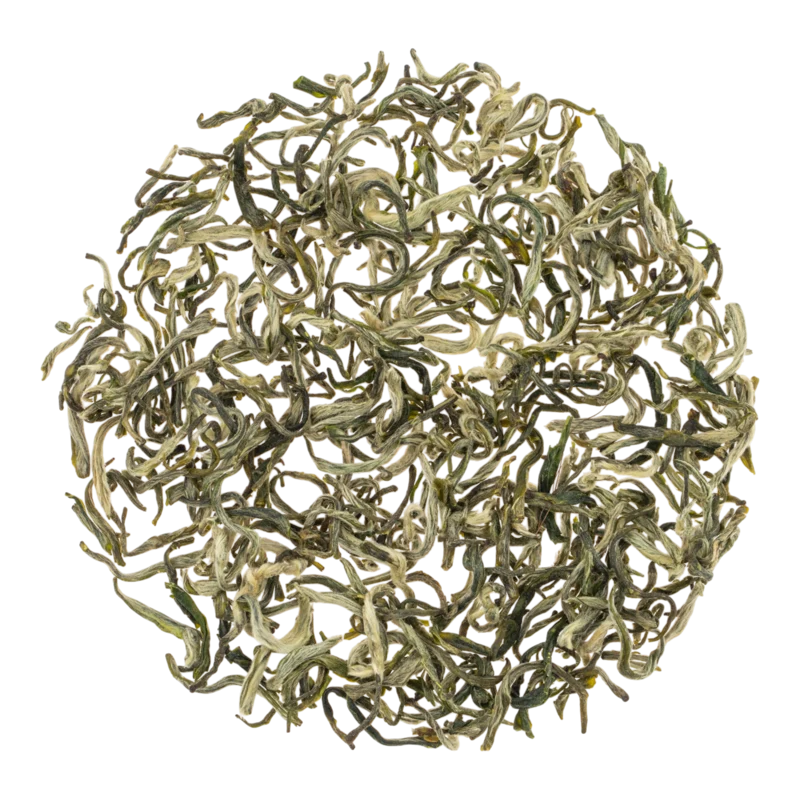
| Special Grade-1 | 纤细, 卷曲呈螺, 满身披毫; 银绿隐翠, fresh and succulent | 嫩香清鲜 — tender, pure | 清鲜甘醇 | 幼嫩多芽, 嫩绿鲜活 |
| Special Grade-2 | same spiral, down slightly less prominent | tender, pure | fresh, sweetish | many buds |
| Grade-1 | dense spiral, visible down | pure | balanced | buds and small leaves |
| Grade-2 | twist coarser, down sparser | pure, simple | denser, simpler | leaves predominant |
| Grade-3 | 绿润 instead of 银绿隐翠 | 纯正 — simply “correct” | balanced, without tenderness | 含单张 — single leaves |
The defining descriptors of the standard are 卷曲呈螺 (“twisted into a spiral-snail”), 满身披毫 (“entirely dressed in down”), and 银绿隐翠 (“silvery-green with a hint of hidden emerald”). Acceptance inspection follows these criteria: if the tea does not produce a spiral and down, the question of grade does not arise at all.
A separate sensory marker of the origin area is the “floral-fruity” note (花香果味, huāxiāng guǒwèi). It comes from the garden, not the wok, and it is precisely this that cannot be reproduced outside Dongting.
7. Chemical Composition:
The complete biochemical profile of Biluochun — catechins, amino acids, alkaloids, vitamins, aromatic complex — is analyzed in the article “Biluochun (碧螺春)”. The Dongting specificity here lies in the fact that some parameters are not descriptive, but normative.
Physical and chemical requirements of GB/T 18957-2008 (Table 2):
| Parameter | Standard |
|---|---|
| Moisture mass fraction (水分) | not more than 7.5% |
| Total ash (总灰分) | not more than 6.5% |
| Water-soluble extractives (水浸出物) | not less than 34.0% |
| Crude fiber (粗纤维) | not more than 14.0% |
Two figures here speak louder than the rest. Extractives not less than 34% — this is a high threshold for green tea, meaning the standard directly demands a dense, full-bodied infusion. Fiber not higher than 14% versus the typical 16–16.5% for green tea — a direct consequence of raw material tenderness: a coarsened leaf physically cannot fit this norm.
From the descriptive part, one thing is worth remembering: in the aroma of Dongting tea, researchers have identified 42 volatile compounds — one of the most complex aromatic profiles among Chinese green teas, and they link this complexity to the interplanting of tea and fruit trees.
8. Health Properties:
The health benefits of Dongting Biluochun are the same as those of any high-quality early spring green tea: antioxidant action of catechins, mild tonic effect from the caffeine and L-theanine combination, support for digestion and the cardiovascular system, strengthening of tooth enamel due to fluoride, refreshing action (生津止渴, shēngjīn zhǐkě), especially valued in the humid climate of Jiangnan. A detailed analysis is in the article “Biluochun (碧螺春)”.
Terroir has almost no influence on this list: the origin area determines aroma and taste, not pharmacology. The information listed is based on publicly available data on green tea composition and does not constitute medical advice.
9. Brewing:
The brewing method for Biluochun — the “top water addition” method (上投法, shàngtóufǎ), where water of 75–80 °C is poured first, then the tea is added — is described in detail with all modes and teaware in the article “Biluochun (碧螺春)”. Boiling water “scalds” the tender downy leaf, producing bitterness.
One test makes sense specifically for Dongting tea. High-grade Dongting Biluochun reveals itself even in cold water: spring or mineral water at room temperature extracts from it a recognizable floral-fruity aroma and sweetness without bitterness in 20–30 minutes. Counterfeits in cold water remain empty or yield a grassy green note — this is a simple home test requiring neither scales nor experience.
10. Storage:
Storage conditions for Dongting Biluochun are common to all early spring green teas: airtight opaque container, darkness, coolness (optimally 0–5 °C), isolation from external odors, best consumed within 6–12 months of production. Details — in the article “Biluochun (碧螺春)”.
One clarification specific to the origin area: fresh tea of the current year (新茶, xīnchá) is valued here noticeably more sharply than for other green teas. Dongting aroma is the aromatics of the garden, volatile and short-lived; last year’s tea remains tasty but ceases to be an argument for the price asked for it.
11. Market and Price Range:
-
Price category: Genuine Dongting Biluochun is one of the most expensive green teas in China. The price of the highest grades (特级一等, 特级二等) can reach several thousand yuan per 500 g. Cost factors: microscopic origin area, completely manual labor, 60–70 thousand buds per 500 g, and an annual volume of about 100–120 tons for the whole of China. The brand value of “Dongting(shan) Biluochun” was estimated at approximately 5.68 billion yuan in 2024 — a figure that by itself explains the scale of counterfeiting.
-
Scale of the problem: The overwhelming majority of “Biluochun” on the market is produced outside Dongting — in Zhejiang, Fujian, Sichuan, Yunnan. Externally, such teas are similar, but lack the “floral-fruity” note and are usually coarser in taste. Genuine tea accounts for about 0.2% of what is sold under this name.
-
How to distinguish:
- Check the standard number on the package. Genuine tea is labeled according to GB/T 18957 “Geographical Indication — Dongting(shan) Biluochun”. An industry standard (NY/T) or enterprise standard (Q/) means that you are looking at tea from another region — legitimate, but not Dongting.
- Assess the fineness of the leaf. Dongting leaf is exceptionally thin, “like copper wire” (铜丝条); the down is natural and evenly distributed. Counterfeits are larger and coarser, and the down is sometimes added artificially — even including loquat fuzz.
- Smell the dry leaf. The natural floral-fruity note is the main marker of the origin area. Counterfeits smell of “raw greens” or earth.
- Evaluate the infusion. Genuine is clear, transparent, tender green; counterfeit is slightly cloudy, yellowish.
- Test with cold water. Genuine Dongting tea reveals itself even in cold water; imitations do not.
- Watch the price. “Top grade” cheaper than 500 yuan per 500 g is practically a guarantee that the tea is made outside Dongting.
12. Authenticity Identification:
-
The annual volume of genuine Dongting Biluochun (~100–120 tons) constitutes only about 0.2% of all tea sold under this name in China. The remaining 99.8% is produce from other regions.
-
Dongting Biluochun is a rare case where both the processing method (National Intangible Heritage, 2011; UNESCO, 2022) and the garden-keeping method are inscribed in heritage registers simultaneously: the agroecosystem of Dongting tea-fruit gardens was recognized as Important Agricultural Cultural Heritage of China in 2020.
-
Genuine Dongting Biluochun, when brewed by the “top water addition” method, sinks to the bottom of the glass rather than floating on the surface — a traditional test of authenticity described as far back as Republican-era notes.
-
In the composition of the aroma, scientists have identified 42 volatile compounds — one of the most complex aromatic profiles among Chinese green teas.
-
The specification 山 (“mountains”) in the official name “洞庭(山)碧螺春” did not appear for beauty’s sake: without it, the name is confused with Hunan’s Dongting Lake, where a completely different tea is made — the yellow Junshan Yinzhen.
13. Recommended Sources:
A comparison of Biluochun with other famous green teas of China — Longjing, Maofeng, Houkui, Anji Baicha, Guapian — is provided in the article “Biluochun (碧螺春)”. Here, another comparison makes sense: Dongting tea versus homonymous teas from other places.
-
Biluochun from Zhejiang, Sichuan, Guizhou, Yunnan. The same spiral, the same down, often the same neat manual work. The difference is one, but decisive: no floral-fruity note of the garden. Instead — pure green freshness, with a grassy or “earthy” undertone in more southern variants. These are legitimate teas, the question is only about the name and price.
-
Yin Luo (银螺, Yín Luó). The closest formal analog: spiral, down, small leaf. Not geographically fixed, made in several provinces from different cultivars, the leaf is usually larger, the profile simpler. The most common way to serve “biluochun” cheaper than genuine.
-
Sanxia Bi Luo Chun (三峽碧螺春). Taiwanese tea from the endemic cultivar Qing Xin Gan Zai (青心柑仔) with a mung bean aroma. The only thing it shares with the Suzhou tea is the name and leaf shape; this is not a fake, but an independent tradition. It is covered in a separate article.
-
Biluochun and “biluochun-hong”. A black tea is also made from the same Dongting raw material; it has no relation to the GI standard GB/T 18957, which regulates precisely the green tea.
In conclusion:
Dongting Biluochun is the quintessence of Jiangnan spring, enclosed in tiny silvery-green spirals. The unique combination of millennial terroir, tea-fruit gardens on Taihu islands, rare small-leaf cultivar, and completely manual technology makes this tea truly inimitable. Its floral-fruity aroma, amino acid sweetness, and most tender liquor texture are not marketing epithets but results of deep biochemical specificity, confirmed in laboratories. Biluochun is tea for those who value refinement, who are ready to slow down and observe how tiny tea leaves, swirling, descend through transparent water to glass bottom, revealing aroma that four centuries ago the pickers themselves gave the most accurate possible name — “frighteningly fragrant.”
the teas described here are available from teamotea