home · article
Bìluóchūn
Bìluóchūn · 碧螺春
Bìluóchūn (碧螺春, bìluóchūn) is one of the greatest Chinese green teas, included in the canonical list of the "Ten Famous Teas of China" (中国十大名茶). It is celebrated for its "four perfections" (四绝): beautiful form — tightly twisted spirals resembling snail shells; elegant color — silvery-green with glimpses of emerald;
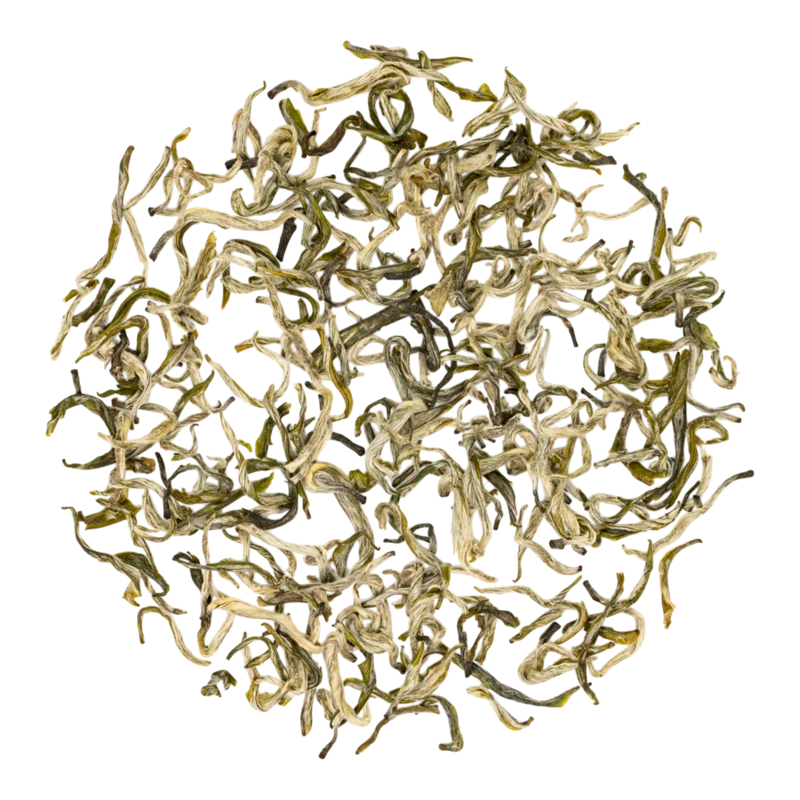
Bìluóchūn (碧螺春, bìluóchūn) is one of the greatest Chinese green teas, included in the canonical list of the “Ten Famous Teas of China” (中国十大名茶). It is celebrated for its “four perfections” (四绝): beautiful form — tightly twisted spirals resembling snail shells; elegant color — silvery-green with glimpses of emerald; rich aroma — dense floral-fruity notes; pure taste — fresh, brisk and sweet. For its unparalleled delicacy and refinement, this tea has earned the poetic nickname “tea fairy” (茶中仙子, chá zhōng xiānzǐ).
1. Classification and Origin:
-
Type: Green tea (non-fermented). Belongs to the pan-fired green teas (炒青绿茶, chǎoqīng lǜchá) with spiral leaf rolling, small-to-medium leaf (中小叶) on the cultivar axis.
-
Category: Included in the list of the “Ten Famous Chinese Teas” (中国十大名茶, Zhōngguó shí dà míngchá). In 2011, the handmade production technique was inscribed on the National Intangible Cultural Heritage Register of the PRC at the state level, and in 2022 — on the UNESCO Representative List of the Intangible Cultural Heritage of Humanity as part of the nomination “Traditional Chinese Tea Processing Techniques and Associated Social Practices”.
-
Origin: China, Jiangsu Province (江苏, Jiāngsū), Suzhou City (苏州, Sūzhōu), Wuzhong District (吴中, Wúzhōng) — the islands and slopes of Dongting Mountain (洞庭山, Dòngtíng Shān) on Lake Taihu (太湖, Tàihú). The right to the name “Dongting Biluochun” (洞庭碧螺春) is secured by the national standard for geographical indication GB/T 18957-2008; the boundaries of the protected zone, its grades, and authenticity verification are discussed in the article “Dong Ting Bi Luo Chun (洞庭碧螺春)”.
-
Geographic coordinates: Approximately 31°05′ North latitude, 120°22′ East longitude.
-
Caution with the name: The 洞庭 in this tea’s name refers to the Dongting Mountains on Lake Taihu in Jiangsu, not Dongting Lake (洞庭湖) in Hunan. The coincidence of names has generated persistent confusion: Hunan’s Dongting Lake is where the yellow tea Junshan Yinzhen is made, which has no relation to Biluochun.
2. History and Cultural Significance:
-
History: The tea-growing traditions of Dongtingshan date back to the Sui and Tang dynasties (6th–10th centuries), when local tea was already known under the names “Dongtingcha” (洞庭茶) and “Xiasharénxiāng” (吓煞人香, xiàshārénxiāng — literally “aroma that makes one faint”). The latter name is vivid folk testimony to how much the extraordinarily intense aroma of this tea amazed contemporaries.
The turning point in the tea’s history is connected with the name of Emperor Kāngxī (康熙, Kāngxī) of the Qing dynasty. In the thirty-eighth year of his reign (1699), Kangxi made an inspection trip to Lake Taihu. Sūzhōu Governor Sòng Luò (宋荦, Sòng Luò) presented the emperor with local tea. Kangxi was captivated by its properties, but considered the common name “Xiasharénxiāng” inappropriate and bestowed upon the tea a new name: “Biluochun” (碧螺春) — which combined three images: “turquoise-green color of the liquor” (碧), “spiral form resembling a snail” (螺) and “spring — the time of harvest” (春). From this moment, Biluochun became one of the “gongcha” (贡茶, gòngchá) — tribute teas for the imperial court.
In modern times, the tea continued to gain fame: in 1915, Biluochun received a gold medal at the Panama-Pacific International Exposition; in 1959, it was included in the official list of “Ten Famous Teas of China”. In 2022, its technology was included in the UNESCO List of Intangible Cultural Heritage.
-
Name:
- “Bi” (碧) — “turquoise,” “jade-green”: indicates the color of the tea liquor and dry leaf.
- “Luo” (螺) — “snail,” “spiral”: describes the characteristic form of the twisted leaf, resembling a miniature shell.
- “Chun” (春) — “spring”: emphasizes that the tea is harvested exclusively in early spring.
-
Cultural significance: Bìluóchūn is the calling card of Sūzhōu and the entire Jiāngnán region (江南), embodying the refined culture of the “southern gardens.” The tea is inextricably linked with the image of Taihu — one of China’s great lakes — and its island landscapes, where tea gardens have neighbored fruit trees for centuries. Biluochun is regularly presented as a state gift, and the spring harvest at Dongtingshan is an important cultural event of the region.
3. Botanical Description and Raw Material:
-
Variety / Cultivar: For the production of authentic Dongting Biluochun, the local indigenous variety is used — Dòngtíngshān Quntichong (洞庭山群体种, Dòngtíngshān Qúntǐzhǒng) — Camellia sinensis var. sinensis of seed (sexual) propagation. This small-leaf variety is distinguished by high “tenderness retention” (持嫩性, chí nèn xìng): shoots maintain softness for a long time. The chemical profile is characterized by a harmonious ratio of polyphenols to amino acids (酚氨比, fēn’ān bǐ): the content of tea amino acids exceeds 2.5%, which ensures pronounced freshness and sweetness. It is precisely Quntichong that is responsible for the famous floral-fruity aroma of Biluochun.
-
Harvest: Harvesting begins in early spring. The most valuable is considered “mingqiancha” (明前茶, Míngqián chá) — tea harvested from the spring equinox (Chunfen, 春分, ~March 20) to the Qīngmíng festival (清明, Qīngmíng, ~April 5). It consists of full buds or the most tender shoots “one bud — one barely opened leaf” and is distinguished by maximum tenderness and brightness of aroma. Tea harvested from Qīngmíng to Gǔ Yǔ (谷雨, Gǔyǔ, ~April 20) — “yuqiancha” (雨前茶, Yǔqián chá) — gives a denser and more saturated taste at a significantly more accessible price. Tea harvested after Guyu is no longer considered classic Biluochun and belongs to the category of ordinary pan-fired green tea (炒青).
-
Harvest standard: For the highest grades — one bud with a barely opened leaflet (一芽一叶初展, yī yá yī yè chū zhǎn). For first grade — one bud with one leaf. For second grade — one bud with two leaflets in the initial stage of opening. For the production of 500 g of dry tea of the highest (特级) grade, 60,000–70,000 buds are required — this is one of the most labor-intensive teas in the world.
-
Raw material requirements: Exceptionally high. Shoots must be of uniform size, whole, without mechanical damage. Harvesting is conducted by hand in the early morning hours. Freshly harvested raw material is immediately sorted (拣剔, jiǎn tī): leaves with defects, coarse fragments, stems, “fish leaves” (鱼叶) are removed. Processing must begin on the same day.
4. Terroir and Cultivation Features:
Biluochun is a tea of a single terroir. Its classic and only protected zone — the East and West Dongting Mountains on Lake Taihu: the lake microclimate, tea-and-fruit plantations, slightly acidic soils, and the boundaries of the geographical indication are analyzed in detail in the article “Dong Ting Bi Luo Chun (洞庭碧螺春)”.
Briefly on why the terroir is important at all: Biluochun’s floral-fruity aroma is born not in the wok, but in the garden — Dongting’s tea bushes grow intermixed with fruit trees and absorb the aromatics of their blossoms. Neither the cultivar nor the technique alone can deliver this.
Where else it is produced. Spiral rolling and small-leaf raw material are reproduced far beyond Jiangsu — in Zhejiang, Sichuan, Guizhou, and Yunnan. The shape of the leaf, the fuzz, and the general appearance are replicated; the Dongting floral-fruity aroma is not. Such teas are correctly called biluochun by type, not by origin. Separately, Taiwan’s Sanxia Bi Luo Chun (三峽碧螺春) stands out: this is a standalone tea from the endemic cultivar Qing Xin Gan Zai (青心柑仔) with a beany aroma, sharing only the name and leaf shape with the Suzhou original — the article “Sanxia Bi Luo Chun (三峽碧螺春)” is dedicated to it.
5. Production Technology:
The production of Biluochun is an entirely manual process, performed according to the principle “hands do not leave the tea, tea does not leave the wok” (手不离茶,茶不离锅). The entire cycle from loading raw material to obtaining finished tea takes about 40 minutes for one batch (one “wok” portion).
-
Harvesting (采摘 — cǎi zhāi): Hand harvesting is conducted in the early morning. The most tender buds with one or two leaflets are picked. Preliminary sorting is conducted simultaneously directly in the basket.
-
Sorting (拣剔 — jiǎn tī): Careful manual removal of damaged, coarse and non-standard leaves, stems and “fish leaves.” The quality of this stage directly determines the uniformity of the final product.
-
Spreading / withering (摊放 — tān fàng): Sorted raw material is spread in a thin layer in a cool, well-ventilated room for several hours. During this time, excess moisture evaporates, and aromatic precursors begin to form.
-
Kill-green / Fixation (杀青 — shāqīng): Leaves are placed in a heated cast iron wok (铁锅) at a temperature of 180–200°C. The master quickly tosses and mixes the raw material with rapid movements, stopping the work of oxidative enzymes and fixing the fresh green aroma. This stage lasts several minutes and requires absolute precision — the slightest overheating will give a burnt taste, underheating — grassiness.
-
Rolling (揉捻 — róuniǎn): When the wok temperature drops to 70–80°C, the master transitions to rolling: leaves are rolled, compressed and twisted, beginning to form the spiral structure. Cell juice emerges on the surface, ensuring rapid extraction during brewing.
-
Rolling into spirals and revealing down (搓团显毫 — cuō tuán xiǎn háo): The key and most virtuosic stage, giving Biluochun its famous form. At a temperature of 60–65°C, the master gathers leaves into small balls and gently rolls them with palms, forming tight spirals. Simultaneously, “down revelation” occurs — fine silvery down (白毫, báiháo) separates from the leaf surface and covers the twisted spirals, giving the tea its characteristic silvery-green appearance. This technique is precisely the hallmark of mastery: the denser the down and tighter the spiral, the higher the quality.
-
Slow-fire drying (文火干燥 — wénhuǒ gānzào): Final drying at reduced temperature 50–60°C. The tea is brought to a stable state, the final aroma is formed. Moisture content in the finished product — no more than 7%.
6. Organoleptic Characteristics:
-
Dry leaf appearance: Fine, tightly twisted spirals (条索纤细蜷曲), resembling miniature snail shells (螺形). Color — silvery-green with glimpses of emerald (银绿隐翠, yínlǜ yǐncuì). The surface is densely covered with delicate white down (白毫密布). The highest grades are characterized by uniformity: each spiral of the same size, without crumbs and coarse fragments.
-
Dry leaf aroma: Intense, complex, with pronounced floral-fruity notes (花果香馥郁, huāguǒ xiāng fùyù) — loquat, bayberry, citrus blossoms. Above the fruity layer — pure green freshness of young shoots (嫩香). The aroma is so bright that it was precisely this that gave the tea its historical folk name “Xiasharénxiāng” — “aroma that makes one faint.”
-
Liquor aroma: High, elegant, persistent (清香高雅持久). Floral-fruity notes dominate, complemented by fresh green sweetness. When the cup cools (冷杯, lěng bēi), honey and vanilla nuances appear, which linger in the cup for several minutes.
-
Taste: Fresh and brisk (鲜爽, xiānshuǎng) — first impression: bright, “living” freshness, due to high amino acid content (≥3.5%). Quick returning sweetness (回甘迅速, huígān xùnsù) — after the first sip, the mouth fills with soft fruity sweetness. Body — medium-dense, soft and round (醇厚, chúnhòu). Polyphenol content (20–24%) provides light structural astringency, but without roughness. Aftertaste — long, refreshing, with a fruity trail.
-
Liquor color: Tender green, clear and transparent (嫩绿清澈). When brewed in a glass, the effect of “snowy waves with pearls” (雪浪喷珠) is observed — white down, separating from the leaf, floats in the liquor, creating a picturesque scene.
-
Spent leaves (wet leaves): Tender, elastic, uniform leaflets of light green color, unfolded from spirals. Retain the form “one bud — one leaf.” The leaf is whole, without damage, of even coloration.
7. Chemical Composition:
The chemical profile of Biluochun is determined by early spring harvest, small-leaf cultivar and unique terroir of Dongtingshan. Below are characteristic indicators for spring harvest tea:
-
Polyphenols (catechins): Content — 20–24% of dry mass. The main component — epigallocatechin gallate (EGCG), providing powerful antioxidant potential. According to comparative studies, the antioxidant effectiveness of Biluochun polyphenols is approximately 30% higher than that of average green tea, which is related to the high proportion of EGCG in the catechin profile.
-
Amino acids: Content — not less than 3.5% of dry mass. L-theanine (茶氨酸, chá’ānjīsuān) predominates, responsible for the sensation of freshness, “umami” note and mild relaxing effect. High amino acid content with moderate polyphenol levels creates a balanced, soft and sweetish taste without pronounced bitterness.
-
Alkaloids: Caffeine content — moderate (approximately 3.0–4.0% of dry mass). The action of caffeine is softened by L-theanine, providing an even, mild tonic effect. Theobromine and theophylline are also present.
-
Vitamins: Vitamin C — content is significant, since early spring harvest and gentle hand pan-firing maximally preserve this unstable vitamin. B-group vitamins (B₁, B₂), vitamin E, carotenoids (provitamin A).
-
Minerals: Potassium, magnesium, zinc, iron, manganese, fluorine. The mineral profile is determined by the weakly acidic yellow soils of Dongtingshan.
-
Essential oils and aromatic compounds: The volatile aromatic complex of Biluochun is exceptionally rich: linalool, geraniol, nerol, cis-jasmone and other terpenoids form the characteristic floral-fruity bouquet. The uniqueness of the aroma is connected with the intercropping system — co-cultivation with fruit trees.
-
Water-soluble sugars and pectins: Give the liquor a soft “body” and sensation of sweetness.
8. Health Properties:
-
Antioxidant action: Catechins (especially EGCG) effectively neutralize free radicals, slowing oxidative stress and cellular aging processes.
-
Tonic effect and cognitive function improvement: Caffeine in combination with L-theanine provides a mild, even energy boost without a sharp peak and subsequent crash. L-theanine additionally promotes concentration and calm focus.
-
Cooling and refreshing action: Biluochun is traditionally classified as a “cool” tea (性凉, xìng liáng), recommended in hot weather for quenching thirst and relieving internal heat.
-
Digestion improvement: Tea polyphenols stimulate the secretion of digestive enzymes, help break down fats and relieve the sensation of heaviness after meals.
-
Cardiovascular system strengthening: Polyphenols and vitamin C contribute to lowering LDL cholesterol levels and strengthening vessel walls.
-
Antibacterial action: Catechins suppress the growth of pathogenic bacteria in the oral cavity, freshening breath.
-
Metabolism support: Caffeine and catechins activate metabolic processes, promoting fat breakdown.
-
Important: the listed properties are based on publicly available data on green tea composition and are not medical recommendations.
9. Brewing:
-
Water temperature: 80–85°C (boiling water, cooled for ~2 minutes). Under no circumstances use steep boiling water — overheating damages the most delicate buds, causing bitterness and aroma loss.
-
Tea quantity: 3 g per 150–200 ml of water.
-
Teaware: Glass tumbler (玻璃杯, bōli bēi) — the best option, allowing observation of the famous “snowy waves with pearls” effect and the unfolding of spirals in water. A white porcelain gaiwan (白瓷盖碗) is acceptable for more precise aroma control. Not recommended to use Yíxīng teapot (紫砂壶) — the tight lid and porous walls will “suffocate” the delicate aroma.
-
Process (top-down infusion method / 上投法, shàng tóu fǎ):
- Warm the glass tumbler with hot water, drain.
- Pour water (80–85°C) to 7/10 of the glass volume.
- Add 3 g of tea — spirals will begin to slowly descend, unfolding and “dancing” in the water.
- Wait until the leaves settle (about 30–40 seconds).
- The first infusion is ready — drink, enjoying the freshness and first fruity notes.
- Second and third infusions — increase time by 10 seconds each. The tea withstands 3 full brewings.
-
Note: the “top-down infusion” method (water first, then tea) is classic for Biluochun. It prevents burning of delicate buds and allows admiring the leaf unfolding. Optimal drinking temperature — about 60°C: it is precisely at this temperature that sweetness and freshness are maximally perceived.
10. Storage:
- Store in airtight containers — porcelain, glass or tin cans — in a dark and cool place, away from foreign odors.
- Optimal storage temperature — 0–5°C (refrigerator), in a separate compartment, excluding contact with products having strong odors. Packaging tightness is critically important: tea is extremely hygroscopic and easily absorbs foreign aromas.
- Avoid exposure to light, moisture and heat — the main “enemies” of green tea.
- After opening the package, it is recommended to consume the tea within one month to preserve maximum freshness.
- Shelf life under proper conditions — up to 12 months, however for the best taste experience it is recommended to drink within 6 months after harvest.
11. Price and Counterfeits:
Biluochun is one of the most expensive green teas in China. The price is shaped by four things: harvest time (mingqiancha is many times more expensive than yuqiancha), grade, fully manual processing, and authenticity of origin.
-
What lies behind the grade: the highest grade requires 60,000 – 70,000 buds per 500 g of finished tea — one of the most labor-intensive indicators in the tea world; hence the price gap between steps. The normative grading scale with the benchmark organoleptics of each step is secured for the protected name and provided in the article “Dong Ting Bi Luo Chun (洞庭碧螺春)”.
-
Price guidelines (for 2024): highest grade (特级) mingqiancha — from 1200 yuan per 50 g and above; first grade (一级) — 300–500 yuan per 500 g; second-to-third grade — significantly cheaper.
-
General purchasing rules:
- Buy from trusted sellers specializing in Suzhou teas.
- Evaluate the fuzz: authentic high-grade Biluochun is densely covered with silvery fuzz. However, an excess of “floury” fuzz that detaches upon touch may indicate artificial addition.
- Evaluate the aroma: genuine Biluochun smells of fresh fruits and flowers — naturally, voluminously, without “perfumery” or chemical notes. Artificial aromatization is perceived as harshness and dissipates quickly.
- Evaluate the infusion: clean, transparent, tender green. A cloudy or dull infusion is a reason for doubt.
-
How to distinguish specifically Dongting tea from biluochun from other provinces — standard marking, fuzz, aroma, price threshold — is analyzed in the article “Dong Ting Bi Luo Chun (洞庭碧螺春)”.
12. Interesting Facts:
-
To produce one jin (500 g) of the highest grade Biluochun, 60,000–70,000 individual buds must be picked and processed — this is one of the most labor-intensive indicators in the tea world.
-
“Snow Waves Spouting Pearls” (雪浪喷珠, xuělàng pēnzhū) — the poetic name for the effect that occurs during brewing: white downy hairs detach from the unfurling spirals and float in the greenish infusion, creating a picture of falling snow.
-
Kangxi, who gave the tea the name “Biluochun,” was a famous connoisseur of fine arts. Renaming “Xia Sha Ren Xiang” to “Biluochun” is one of the most famous examples of “imperial naming” in the history of Chinese gastronomy.
-
Biluochun is one of the few Chinese teas for which the “top pouring” method (上投法) is traditionally used for brewing: first the water is poured, then the tea is added. For most other green teas, the opposite order is accepted.
-
The cellulose content in Biluochun by standard is allowed to be no more than 14.0% — noticeably stricter than the general norm for green tea (16–16.5%). This is a direct consequence of the tenderness of the raw material: the buds and barely opened leaf buds simply do not have time to coarsen.
13. Comparison with Other Famous Chinese Green Teas:
-
Xi Hu Long Jing (西湖龙井, Xīhú Lóngjǐng): From Zhejiang Province. Flat leaf, chestnut-beany aroma, “structural” taste with a pronounced “umami” note. Biluochun is the complete opposite in shape (spiral vs. flat) and aromatic profile (floral-fruity vs. chestnut-beany). If Long Jing is “architectural” rigor, then Biluochun is “picturesque” softness.
-
Huangshan Mao Feng (黄山毛峰, Huángshān Máo Fēng): From Anhui Province. Leaf in the shape of “bird’s tongues” with white fuzz, soft floral aroma, delicate taste. Mao Feng is softer and gentler; Biluochun is brighter and fruitier, with a more intense aroma.
-
Taiping Hou Kui (太平猴魁, Tàipíng Hóu Kuí): From Anhui Province. Large flat leaves, orchid aroma, deep herbaceous taste. The contrast is striking: Hou Kui is the largest leaf among famous green teas, Biluochun is one of the most miniature.
-
Anji Bai Cha (安吉白茶, Ānjí Bái Chá): From Zhejiang Province. Green tea from albino shoots with a record amino acid content (6–7%). Anji Bai Cha is “pure sweetness and umami” without pronounced fruitiness, whereas Biluochun is, above all, the richness and volume of a floral-fruity aroma.
-
Liu’an Gua Pian (六安瓜片, Liù’ān Guā Piàn): From Anhui Province. Flat “pumpkin seeds” made from leaves only, without buds. The taste is thick and herbaceous, with notes of roasted seeds. Biluochun is more tender, light, and aromatic.
-
Yin Luo (银螺, Yín Luó): The closest formal analogue in appearance — the same spiral, the same fuzz. But Yin Luo is not geographically fixed, is made in several provinces from different cultivars, is larger in leaf size, and lacks the floral-fruity aroma. This is the most frequent way to serve “biluochun” cheaper than the real thing.
In conclusion:
Biluochun is the embodiment of spring in a tea cup: each tiny spiral, unfolding in warm water, releases the aroma of blooming gardens of Dongtingshan, the freshness of morning mist over Taihu and the sweetness of first fruits. This is tea for those who seek not just a beverage, but an aesthetic experience — from contemplating “snowy pearls” in a glass tumbler to the long fruity aftertaste, reminding us that the best teas are born where nature and human mastery are in perfect balance.
the teas described here are available from teamotea