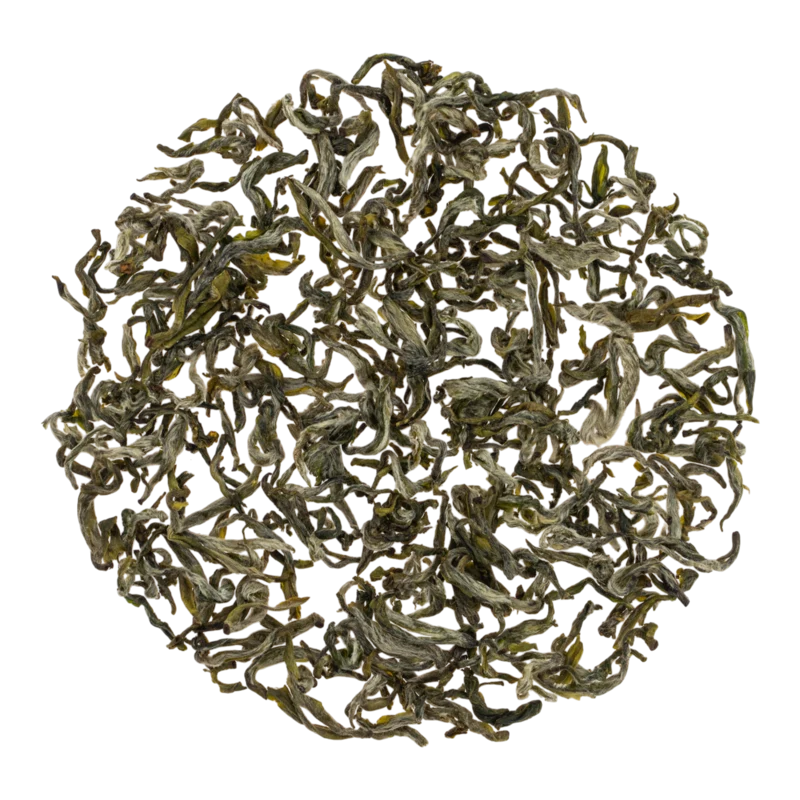
Linglong Lü Cha (玲珑绿茶, Línglóng lǜchá) is a green tea of unique “hook-shaped” form from Guidong County (桂东县, Guìdōng Xiàn) in Hunan Province, located in the very heart of the Luoxiao Range (罗霄山脉, Luóxiāo Shānmài), the mountainous watershed between Hunan and Jiangxi. The name “Linglong” (玲珑, Línglóng, “exquisite / refined”) conveys the shape of the tea leaf: a tight spiral “hook” (环钩, huángōu), bent into a ring, an authorial form created by the method of “hézhǎng cuōróu” (合掌搓揉, hézhǎng cuōróu, “rubbing between palms”) and protected as intangible cultural heritage of Hunan Province (2012). Amino acids in spring tea are 5.15% (40% above average), which ensures exceptional freshness and “juiciness” of taste. Forest cover in Guidong County is 82% (the maximum in Hunan), and the content of negative ions in the air is certified by the Guinness Book of Records.
1. Classification and Origin
-
Type: Green tea (绿茶, lǜchá), non-fermented. Unique “hook-shaped” form (环钩状, huángōu zhuàng) - a “bent hook”, closed into a ring. Fixation technology is pan-firing (炒青, chǎoqīng) with final low-temperature drying at 50–60°C.
-
Category: Product of geographical indication of the PRC (国家地理标志产品, 2012). Intangible cultural heritage of Hunan Province (省级非遗, shěngjí fēiyí, 2012 - the technology of “huángōu dìngxíng” (环钩定形, huángōu dìngxíng, “forming hook-ring”)). Gold medal of the Ministry of Agriculture of the PRC (国家农牧渔业部金奖, 1980). Gold medal of the Fifth Asia-Pacific International Trade Fair (1994). By 2025 — 149,000 mu of tea gardens, 4,700 tons of products, 520 million yuan in total value.
-
Origin: China, Hunan Province (湖南省, Húnán Shěng), Chenzhou City (郴州市, Chēnzhōu Shì), Guidong County (桂东县, Guìdōng Xiàn). Luoxiao Range (罗霄山脉), elevation 500–1500 m. Place of origin — Tongluo Village (铜锣村, Tóngluó Cūn), Qingquan Township (清泉镇, Qīngquán Zhèn), Linglong group of households (玲珑组, Línglóng Zǔ).
-
Geographic coordinates: Approximately 26°05′ N, 113°55′ E.
2. History and Cultural Significance
-
Legend of the “Mountain Mother-Fairy” (山母仙, Shānmǔ Xiān). According to a legend of the Ming–Qing era, a fairy named “Mountain Mother” descended on horseback to Mount Linglong and in one night taught the local residents the art of tea making, visiting every household and repeating the lesson three times. At dawn she flew away on a cloud, having no time to feed the horse. On the mountaintop, a depression in the rock remained — the “Horse Trough” (马归槽, mǎ guī cáo), shaped like a feeding trough and filled with water all year round. This place is still revered today.
-
Qing dynasty chronicle. In the “Qianlong Guidong Xianzhi” (乾隆《桂东县志》, “County Chronicle of Guidong in the Qianlong Era”), unique customs of using tea in life-cycle rituals are recorded. The wedding bride price included tea and salt: “以茶盐行聘,象征海誓山盟” — “Tea and salt at betrothal symbolize the oath of mountains and seas”. At the birth of a baby, it was bathed in tea infusion for protection against diseases. The deceased had tea leaves placed in the mouth — “so that the soul does not get lost and the body does not decay”. A saying ran: “宁可终生不饮酒,不可一日不喝茶” — “Better not to drink wine all your life than not to drink tea for one day”.
-
“Zhongguo Chajing” (《中国茶经》, “The Chinese Tea Canon”). The authoritative edition records: “玲珑佳茗,产于湘南桂东,群山之腰,苍松翠竹,阴晴朝暮,山岚雾嶂,藏玲珑茶之园也” — “The excellent tea Linglong grows in the south of Hunan, in Guidong County, on the belt of mountains, among old pines and green bamboo, in clouds and mists that shelter the tea gardens of Linglong”.
-
1929 — “Hunan ge xian techan diaocha biji” (《湖南各县特产调查笔记》). Record: “茶叶为八面山天然产,饮之凉生两胁,可以消烦涤虑” — “Tea is a natural product of Bamian Mountain; when drunk, coolness arises on both sides of the ribs, capable of dispelling anxiety and cleansing thoughts”.
-
1965 — official name. Wang Yanchun (王延春, Wáng Yánchūn), secretary of the provincial committee of the CPC of Hunan, having visited Linglong Township, named the tea “Linglong Cha” (玲珑茶) — after the name of the group of households where it was first made.
-
1980 — gold medal. Linglong Cha first participated in the national tea evaluation and received the gold medal of the Ministry of Agriculture, Animal Husbandry and Fisheries of the PRC. In 1985 — a repeated departmental award. In 1994 — the gold medal of the first “Xiangcha Bei” (湘茶杯, “Hunan Tea Cup”) competition and the gold medal of the Fifth Asia-Pacific International Trade Fair. In 2012 — registration of geographical indication and assignment of intangible cultural heritage status. In 2016 Linglong Cha was presented at international exhibitions in Las Vegas and Milan, drawing enthusiastic reviews from foreign tasters.
-
Name. 玲珑 (Línglóng) — “exquisite”, “refined”, “filigree”. The character 玲 (líng) contains the radical “jade” (玉), emphasizing preciousness; 珑 (lóng) — “jade ring”, “transparency”. Together — “jade transparency”, which accurately conveys the character of the tea leaf: miniature, tight, as if carved from jade. 绿茶 (lǜchá) — “green tea”.
-
Cultural significance. Guidong is one of the most ecologically clean counties of Hunan: 82% of forest cover (maximum in the province), a Guinness record for the content of negative ions in the air, reputation as a “healing paradise and summer resort” (养生天堂、避暑胜地). Linglong Cha is the tea-symbol of this “green fortress”, inseparably linked with the mountain culture of southeastern Hunan.
3. Botanical Description and Raw Material
-
Cultivar / Varietal: Local population variety (本地群体种, běndì qúntǐ zhǒng), belonging to Camellia sinensis var. sinensis. Medium-leaved, early vegetation, abundant pubescence (白毫, báiháo). In the county, wild ancient tea trees over 100 years old have been discovered — evidence of the autochthonous origin of tea culture. Biochemical profile of the leaf: amino acids — 5.15%, polyphenols — 29.98%, caffeine — 6.78%. Phenol-amino acid ratio (酚氨比, fēn’ān bǐ) — 0.17 — exceptionally low, which ensures the flavor formula “鲜醇耐泡” (xiān chún nài pào, “fresh, mellow, enduring”).
-
Harvest: Spring harvest (春茶, chūnchá) is the main one. The highest grade is single buds harvested before Qingming. The first grade is “one bud + one leaf at initial opening” (一芽一叶初展, yī yá yī yè chūzhǎn). The second grade is “one bud + two leaves” (一芽二叶).
-
Harvest standard: Buds must be intact, with dense silvery down. The requirement for uniformity is maximum: the length of shoots in a batch should not deviate by more than 15%.
-
Grades: Highest (特级, tèjí): single bud — from 2800 yuan/500 g (2024). First (一级, yījí): one bud + one leaf — 800–1200 yuan. Second (二级, èrjí): one bud + two leaves — mass grade.
4. Terroir and Cultivation Features
-
Topography and climate. Guidong County is located on the Luoxiao Range (罗霄山脉), which is the watershed between Hunan and Jiangxi. From the northeast it is bordered by the Wanyang Mountains (万洋山, Wànyáng Shān), from the southeast — by Zhuguang Mountains (渚广山), from the west — by Bamian Mountain (八面山, Bāmiàn Shān, up to 2042 m — one of the highest peaks of Hunan). Average annual temperature — 16°C. Precipitation — ~1500 mm. Cloudiness — over 180 days a year. Diffuse light — more than 70%. Daily temperature drop — over 8°C. Average relative humidity — 82%.
-
Growing elevation: 500–1500 m above sea level.
-
Soils: Yellow on granite base (花岗岩风化黄壤, huāgāngyán fēnghuà huángrǎng). pH — 5.5–6.5. Organic content — ≥2%. Loose structure, deep profile.
-
Ecology. Forest cover — 82% (the maximum in Hunan). The content of negative ions in the air — certified by the Guinness Book of Records (recognition of the Shanghai Committee “Da Shijie Jinisi”, 上海大世界基尼斯). SGS certification on 481 parameters of EU standards — all indicators “not detected” (未检出), except for the content of proteins and amino acids.
-
Core of production. Qingquan Township (清泉镇, Qīngquán Zhèn), Tongluo Village (铜锣村) — the historical place of origin; tea gardens laid back in the Ming era. Qiaotou Township (桥头乡, Qiáotóu Xiāng) — the largest plantation zone, ~10,000 mu, provides ~60% of the highest grade.
5. Production Technology
Authorial technology with the key stage — “huángōu dìngxíng” (环钩定形, huángōu dìngxíng, “forming hook-ring”) — recognized as intangible cultural heritage of Hunan Province (2012). A total of 8 main stages:
-
Spreading (摊放, tānfàng): 2–6 hours on bamboo sieves. Partial evaporation of moisture, beginning of enzymatic transformations.
-
“Killing the green” (杀青, shā qīng): Temperature — 120–130°C — noticeably lower than for most pan-fired green teas (usually 160–220°C). Gentle fixation preserves maximum down and delicate texture.
-
Wind cooling (清风, qīngfēng): Rapid dissipation of heat to stop thermal impact.
-
Rolling (揉捻, róuniǎn): Cell destruction by 30–40% — enough for extractability, but without loss of shape.
-
Initial drying (初干, chūgān): Bringing to the state of “does not stick to hands”, down begins to show.
-
“Forming the hook and raising the down” (整形提毫, zhěngxíng tíháo): The key operation — “two-handed counter-rotational twisting” (双手反旋搓条, shuāngshǒu fǎnxuán cuōtiáo). The master takes a portion of tea in both palms and rotates them in opposite directions, twisting the tea leaf into a tight spiral “hook”, closed into a ring. The movement is slow, the pressure is even. Upon reaching ~80% dryness, they move to “raising the down” (提毫, tíháo): the palms squeeze the tea and smoothly rotate, allowing the tea leaves to rub against each other until the silvery down appears on the surface. Mechanical pressing is prohibited (禁用机械压条, jìnyòng jīxiè yātiáo) — the “hook-ring” shape is achievable only by hand.
-
Cooling and “moisture return” (摊凉回潮, tānliáng huícháo): Equalizing moisture between the surface and the core of the tea leaf.
-
Final drying (足火, zúhuǒ): 50–60°C to a moisture content of ≤6%. Low temperature preserves the fragile “hook” shape and down.
6. Organoleptic Characteristics
-
Dry leaf appearance: Tight spiral “hooks”, closed into rings (紧细弯曲, 环钩状, jǐnxì wānqū, huángōu zhuàng). Color — emerald green with oily shine and abundant silvery down (翠绿油润显银毫, cuìlǜ yóurùn xiǎn yínháo). The tea leaves are exceptionally miniature and uniform.
-
Dry leaf aroma: Clean (清香, qīngxiāng), fresh, with a chestnut undertone in spring tea. The highest grade has a light “tender” (嫩香, nènxiāng) note with a hint of young greenery.
-
Infusion aroma: Chestnut (栗香, lìxiāng) with a clean vegetal background. The aroma is persistent — the cold cup retains the smell for over 10 minutes.
-
Taste: Fresh and mellow (鲜醇, xiānchún) — the result of a record 5.15% amino acids. Sweet and refreshing (甘爽, gānshuǎng). The formula “dense, but not astringent” (浓而不涩, nóng ér bú sè) — an ideal balance of polyphenols (29.98%) and amino acids with a phenol-amino acid ratio of 0.17. Sweet aftertaste is quick and persistent.
-
Infusion color: Yellow-green, clean and bright (黄绿明净, huánglǜ míngjìng).
-
Wet leaf (brewed leaf): Tender, uniform, in “bouquets” (嫩匀成朵, nèn yún chéng duǒ) — the shoots open in groups, demonstrating integrity. Color — bright green.
7. Chemical Composition
-
Amino acids: 5.15% — 40% higher than the average for green teas. L-theanine dominates, providing freshness, umami-like sweetness and a relaxing effect.
-
Polyphenols (茶多酚): 29.98% — in the upper range for green teas. The main components are catechins (EGCG, EGC, EC, ECG) with pronounced antioxidant activity.
-
Caffeine (咖啡碱): 6.78% — above average (typical range for green teas is 2–4%). The high content is explained by the genetics of the local variety and environmental conditions. Provides an energetic tonic effect.
-
Phenol-amino acid ratio (酚氨比): 0.17 — exceptionally low (for most green teas it is 5–10 and higher). This means an absolute dominance of freshness over astringency — a rare characteristic.
-
Water-extractable substances: ≥43.3% — high extractability, “full-bodied” infusion.
-
Vitamins: Vitamin C (ascorbic acid), B₁ (thiamine), B₂ (riboflavin), P (rutin), carotenoids. The content of vitamins in high-mountain spring green teas is usually maximal among all tea types.
-
Minerals: Potassium (K), phosphorus (P), magnesium (Mg), calcium (Ca), manganese (Mn), iron (Fe), zinc (Zn), fluorine (F).
-
Essential oils: Terpene alcohols (linalool, geraniol), responsible for the clean chestnut-floral aroma.
8. Health Benefits
-
Potent antioxidant action. Polyphenols (29.98%) neutralize free radicals, reducing oxidative stress. Catechins (especially EGCG) are among the strongest natural antioxidants.
-
Pronounced tonic effect. Caffeine (6.78%) in combination with L-theanine provides a stable, “clean” tone — without anxiety and “caffeine crash”. The effect is described as “conscious alertness”.
-
Cardiovascular support. Catechins contribute to lowering LDL cholesterol, maintaining vascular wall elasticity and normalizing blood pressure.
-
Metabolic support. Polyphenols activate lipid metabolism, promote thermogenesis. Regular consumption of green tea is associated with improved body weight indicators.
-
Immunomodulatory action. Amino acids (5.15%) and polyphenols jointly stimulate the immune response. L-theanine enhances the production of γ-interferon.
-
Cognitive functions. L-theanine increases the level of alpha brain waves, promoting concentration and creative thinking. Caffeine improves reaction speed and working memory.
-
Oral health. Fluoride and catechins inhibit the growth of pathogenic bacteria, contributing to caries prevention and strengthening tooth enamel.
-
Neuroprotective action. EGCG and L-theanine demonstrate in studies the potential to protect nerve cells from oxidative damage.
9. Brewing
-
Water temperature: 80–85°C. For the highest grade (一芽, single bud) — 75°C, so as not to “burn” the delicate buds and preserve the down.
-
Amount of tea: 3 g per 150 ml (ratio 1:50).
-
Teaware: A tall glass cup (玻璃杯) — ideal for observing the unfolding of “hook-rings” (a spectacular process: tight spirals slowly unfurl, “coming alive” in water). A white porcelain gaiwan (盖碗) — for more precise control of extraction.
-
Process:
- Warm the teaware with boiling water, pour it off.
- Add 3 g of tea.
- “Middle pouring” (中投法, zhōng tóu fǎ): Pour 1/3 of the volume of water (80°C) → let the tea soak for ~1 minute → fill with water to 7/10 of the volume.
- First infusion — 3 minutes.
- Withstands 3 full infusions.
10. Storage
- Container: Airtight — vacuum foil bags, tin cans with tight lids. Avoid transparent containers.
- Temperature: Refrigerator, 0–5°C. For long-term storage — freezer (−18°C) in double vacuum packaging.
- Enemies of tea: Moisture, light, foreign odors, oxygen, heat.
- Shelf life: 12 months from the production date under proper conditions. When taking out of the refrigerator — let the package reach room temperature before opening.
11. Price and Counterfeits
-
Price range (2024):
- Highest (特级): single bud — from 2800 yuan per 500 g (minqiancha, 明前茶, pre-Qingming harvest).
- First (一级): one bud + one leaf — 800–1200 yuan per 500 g.
- Second (二级): mass grade — 200–500 yuan per 500 g.
-
Cost factors: Raw material grade, harvest time (minqiancha — premium), fully manual shaping (the “huángōu dìngxíng” technology cannot be mechanized), harvest elevation.
-
How to avoid counterfeits:
- Buy tea with the geographical indication mark “玲珑绿茶” and a certificate of origin.
- The key sign of authenticity is tight “hook-rings” (环钩), not straight strips. If the tea leaves are straight — it is not Linglong Cha.
- Silvery down (银毫) must be abundant and even — a sign of manual processing.
- The infusion is yellow-green, clean, without turbidity. The aroma is clean, chestnut, without musty or sour notes.
- A suspiciously low price (less than 100 yuan per 500 g for the “highest grade”) is a sure sign of counterfeit.
12. Interesting Facts
-
“Hook-ring” — the only form in the world. Among hundreds of varieties of Chinese green tea, the “huángōu” (环钩) form — a tight spiral hook closed into a ring — is not found in any other tea. This form is achievable only by manual “two-handed counter-rotational twisting” and fundamentally cannot be mechanized.
-
Legend of the “Mountain Mother-Fairy”. “Shanmu Xian” (山母仙) on horseback taught the residents of the whole village the tea craft in one night. The “Horse Trough” (马归槽) on the mountaintop — a rock depression filled with water all year round — is revered as a material evidence of the legend.
-
Guinness record for negative ions. Guidong County is certified by the Shanghai Committee “Da Shijie Jinisi” as the “county with the highest content of negative ions in the air”. This is a rare case when a tea terroir is confirmed by a world ecological record.
-
82% of forest — maximum in Hunan. Guidong is the “greenest” county of the province. The county center is located at an elevation of 840 m — the highest in Hunan.
-
5.15% amino acids, phenol-amino acid ratio 0.17. One of the most “amino-acid-rich” green teas of China. The ratio of 酚氨比 = 0.17 means that freshness absolutely dominates over astringency — a parameter comparable to Japanese gyokuro (玉露) grown in deep shade.
-
481 parameters of SGS — “all clean”. When tested against EU standards, all 481 parameters of pesticides and contaminants showed the result “not detected” — the only thing that was detected was proteins and amino acids “in a proportion higher than in rice”. This result became the basis for export of Linglong Cha to European markets.
-
Wedding tea. Guidong County is one of the few areas of China where tea is still used in wedding ceremonies as a ritual gift: “Tea and salt at betrothal symbolize the oath of mountains and seas”. The tradition, recorded in Qing chronicles, is alive in the 21st century.
-
Caffeine 6.78% — higher than most green teas. With a typical range of 2–4% for green teas, Linglong demonstrates a caffeine content comparable to some red teas. This fact makes it one of the most “invigorating” green teas of China.
13. Comparison with Other Green Teas
-
Nanyue Yunwucha (南岳云雾茶, Hunan). Both are Hunan high-mountain green teas. Yunwucha has a spiral or flat shape, chestnut-orchid aroma, tied to the “sacred mountain” Hengshan. Linglong has a unique “hook-shaped” form. Yunwucha — amino acids ~3.5%, Linglong — 5.15%. Yunwucha is more historically famous (Tang dynasty “gongcha”); Linglong is more environmentally certified.
-
Junshan Yinzhen (君山银针, Hunan). Formally a yellow tea, but often compared with Hunan green teas. Yinzhen — single buds, straight shape, “smothering” (闷黄) gives softness. Linglong — “hooks”, without “smothering”, fresher and more tonic due to high caffeine (6.78%).
-
Anji Baicha (安吉白茶, Zhejiang). Another “record holder” in amino acids (~6–7%). Flat shape, delicate taste. Differences: Anji is an albino cultivar “Bai Ye Yi Hao” (白叶一号), Linglong is a population variety; Linglong has higher polyphenols (29.98% vs. ~12–14% for Anji) and caffeine (6.78% vs. ~2.5%); Anji is more “light” and “watery”, Linglong is more “dense” and persistent.
-
Biluchun (碧螺春, Jiangsu). Also has a spiral shape, but different: Biluochun — tight spirals with down, Linglong — “hook-rings”. Biluochun — fruity-floral aroma (co-cultivation with fruit trees), Linglong — chestnut. Both are highly valued, but Biluochun is a nationally recognized brand of the “ten great teas”, Linglong is regional.
-
Pingwu Lü Cha (平武绿茶, Sichuan). Both are high-mountain, with record amino acids (≥5%). Pingwu — selenium-zinc terroir, “yin-yang fire” on pine wood; Linglong — Guinness ecology, unique hook-shaped form. Endurance: Pingwu — 5–7 infusions, Linglong — 3. Both are “hidden gems” of regional tea culture.
In conclusion:
Linglong Lü Cha is a tea whose form is unlike any other green tea in the world: tight “hook-rings” created by “two-handed counter-rotational twisting” — a technology that cannot be mechanized and which, according to legend, was passed to people by the “Mountain Mother-Fairy” on horseback. 5.15% amino acids, phenol-amino acid ratio 0.17, 82% forest, Guinness record for negative ions, and 2800 yuan per 500 g of minqiancha — all this makes Linglong Lü Cha one of the most unusual and valuable green teas of Hunan. A tea for those who seek a form, taste and history that exist nowhere else.