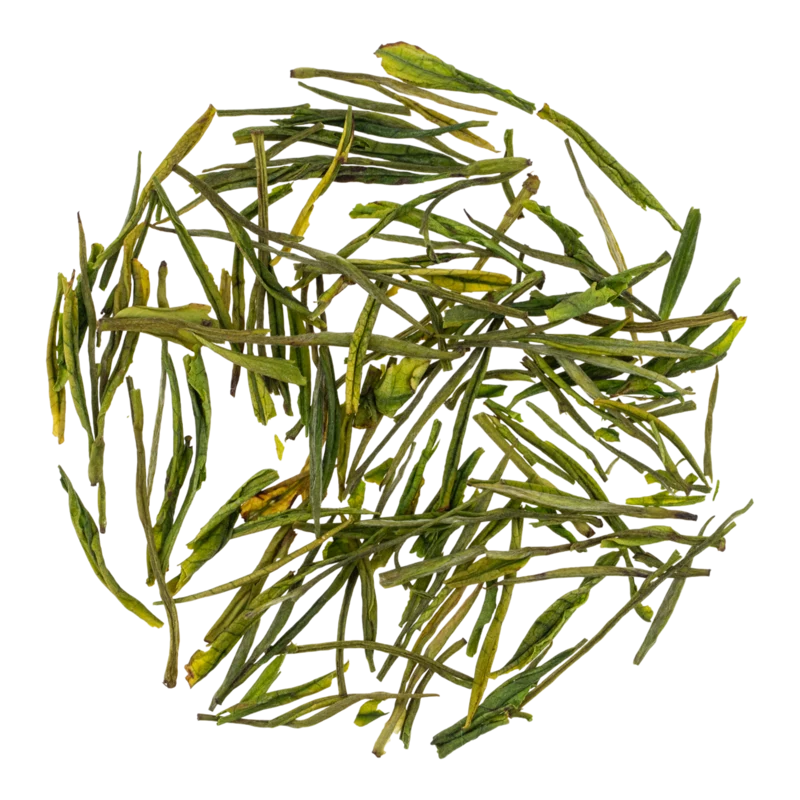
Pan’an Yunfeng (磐安云峰, Pánān yún fēng) — “Cloud Peak of Pan’an County” — is a green tea from Pan’an County (磐安县) of Jinhua City (金华市), Zhejiang Province, located in the Dapanshan mountain range (大盘山脉), which is called “群山之祖、诸水之源” (“Ancestor of mountains, source of all waters”): here originate four major river systems — Qiantang River (钱塘江), Ou River (瓯江), Ling River (灵江), and Cao’e River (曹娥江). The tea tradition of Pan’an dates back to the Jin dynasty (3rd–5th centuries): according to legend, the Taoist sage Xu Xun (许逊, “True Sovereign”, 真君大帝) — one of the “Four Great Heavenly Masters” (四大天师) — while wandering through the mountains of Pan’an, saw wild tea trees, taught local peasants processing techniques, and created the famous “Wuzhou Dongbai” (婺州东白, “Eastern White of Wuzhou”). Lu Yu in “The Classic of Tea” included “Wuzhou Dongbai” among famous teas, noting “大盘山、东白山产者佳,列为贡品” — “that from Dapanshan and Dongbaishan is best, listed as tribute tea”. Within the county lies Yushan Guchachang (玉山古茶场, “Ancient Tea Market of Yushan”) — the only fully preserved ancient tea market in China (founded in the Song, rebuilt in the Qing, area 3430 sq.m), a National Key Cultural Relic Protection Site (全国重点文物保护单位). In 2022, “Gan Chachang” (赶茶场, “Tea Market Fair” — a folk festival of Pan’an) became part of the “Traditional Chinese tea processing techniques and associated practices” inscribed on the UNESCO Intangible Cultural Heritage list.
Quality formula: “三绿一香” (sān lǜ yī xiāng, “three greens — one aroma”): green leaf strip, green infusion, green infused leaf + orchid aroma. Organic matter in soils — 3.5–14.8% — one of the highest ranges among all tea regions of China. Water-soluble extractives — 47% (with a national standard of 36%, exceeding by 11 percentage points). Forest cover — 80.1%. Brand value — 23.51 billion yuan (2024).
1. Classification and Origin
-
Type: Green tea (绿茶, lǜchá), unfermented. Half-pan-fried, half-baked (半炒半烘, bàn chǎo bàn hōng). Two forms: strip-shaped (条形, tiáo xíng — “needle-shaped”, primary) and flat (扁形, biǎn xíng). Author’s shaping technique “抖捺理” (dǒu nà lǐ) — “shaking, pressing, aligning” — alternating three manual techniques to preserve whole shoots and form the characteristic “needle” structure.
-
Category: Product of Geographical Indication of the PRC (国家农产品地理标志产品, 2020). “National Famous Tea” (全国名茶, Ministry of Commerce, 1986). “Cultural Tea” of the Hangzhou Tea Festival (文化名茶, 1991). County-level Intangible Cultural Heritage (县级非遗, 2021 — technique). “Gan Chachang” (赶茶场) — part of UNESCO heritage (2022). Tang dynasty “tribute tea” (婺州东白). Yushan Guchachang — National Key Cultural Relic Protection Site.
-
Origin: China, Zhejiang Province (浙江省), Jinhua City (金华市), Pan’an County (磐安县). 14 townships and towns. Dapanshan mountain range (大盘山脉), 600–1200 m. Coordinates: 120°17′–120°47′ E, 28°49′–29°19′ N.
2. History and Cultural Significance
- History:
Pan’an is a “pure mountain county” (纯山区县), one of the most mountainous in Zhejiang, “群山之祖、诸水之源” — “Ancestor of mountains, source of all waters”. Tea history begins in the Jin dynasty (3rd–5th centuries): the Taoist sage Xu Xun (许逊, 239–374), venerated as the “True Sovereign” (真君大帝) and one of the “Four Great Heavenly Masters” (四大天师) — alongside Zhang Daoling, Ge Hong, and Sa Shoujian — while wandering through the Yushan mountains in Pan’an, discovered wild tea trees and taught local peasants improved processing techniques. The result was “Wuzhou Dongbai” (婺州东白) — a tea that became famous throughout China. Xu Xun is a real historical figure, a native of Nanchang, renowned for flood control on the Gan River; the Daoist tradition of the Jingming school (净明道) venerates him as its founder. Song dynasty tea farmers of Yushan, grateful to Xu Xun, erected the “Chachangmiao” (茶场庙, “Tea Market Temple”) in his honor, where he is worshipped as the “tea deity” (茶神) to this day — the only temple in China where a Taoist sage is venerated specifically as the patron of tea. In the Tang dynasty, Lu Yu included “Wuzhou Dongbai” in “The Classic of Tea”, noting: “大盘山、东白山产者佳,列为贡品” — the tea became a “tribute tea”. In the Song dynasty, around the Tea Market Temple arose Yushan Guchachang — one of the oldest tea trading markets in China, where the state conducted the “tea monopoly” (榷茶, quèchá). The current building (Qing dynasty, area 3430 sq.m) includes the Temple, administrative premises, and a trading hall — the only fully preserved ancient tea market in China (全国唯一保存完整的古代茶叶市场遗址).
In 1979, based on the Tang dynasty “Wuzhou Dongbai” and incorporating techniques of Xihu Longjing, Taiping Houkui, and Emei Erui, the modern “Pan’an Yunfeng” was created. In 1983 — restoration of Pan’an County (previously part of Dongyang): the Dapanshan and Dongbaishan mountains were divided between two counties, and Pan’an “inherited” Dapanshan, while Dongyang took Dongbaishan. This necessitated a new name — “Yunfeng” (“Cloud Peak”). In 1986 — “National Famous Tea” (Ministry of Commerce). In 2020 — Geographical Indication. In 2022, “Gan Chachang” (赶茶场) — a folk fair-festival at the ancient tea market of Yushan — became part of the UNESCO heritage “Traditional Chinese tea processing techniques and associated practices”.
-
Name: 磐安 (Pánān) — name of the county; 云峰 (Yún Fēng) — “cloud peak” — an image of mountain summits shrouded in clouds. Full meaning: “Cloud Peak of Pan’an”. Brand slogan: “道骨仙风,磐安峰” — “The spirit of Dao and the wind of immortals — the peak of Pan’an”.
-
Cultural significance: Pan’an — “群山之祖、诸水之源” (“Ancestor of mountains, source of all waters”): the watershed of four great rivers of Zhejiang. The connection with Taoism (Xu Xun — one of the “Four Heavenly Masters”), the ancient tea market, and UNESCO heritage make Pan’an Yunfeng a tea where “nature, Dao, and trade” have interwoven for 1700 years.
3. Botanical Description and Raw Material
-
Cultivar: Primary — Muhe Quntizhong (木荷群体种) — an indigenous local cultivar adapted to the mountain misty climate. Additionally: Longjing 43 (龙井43), Wuniu Zao (乌牛早). Highest grade: single bud or one bud + one leaf, shoot length ≤3.5 cm.
-
Harvest: Spring — before Qingming. Standard varies by grade: highest — single buds (90%+ down); first — one bud + one leaf (≥90%); second — one bud + two leaves.
-
Grades:
- Highest (特级): Full bud, down ≥85%. From 2000 yuan/500 g.
- First (一级): One bud + one leaf ≥90%. 800–2000 yuan.
- Second (二级): One bud + two leaves. 300–800 yuan.
4. Terroir and Cultivation Features
Pan’an — “纯山区县” (pure mountain county): mountains occupy 100% of the territory. Dapanshan (大盘山, 1245 m) — the main peak, “the roof of four rivers”.
-
Growing altitude: 600–1200 m. Core — 800+ m.
-
Climate: Subtropical monsoon. Average annual temperature — 16.1 °C. Precipitation — 1570 mm. Foggy days — ≥200. Humidity — ≥85%. “Mountains are high, waters are clear, forests are dense, fogs are heavy” (山高水秀、林密雾重) — the terroir formula.
-
Soils: Red-yellow soils (红黄壤, pH 4.5–5.5). Soil horizon depth — 50–100 cm. Organic matter — 3.5–14.8% — one of the highest and broadest ranges among tea regions of China. Mountain spring water with minimal mineralization.
-
Ecology: Forest cover — 80.1%. Pan’an — National Ecological Civilization Demonstration County (国家级生态文明建设示范县). Zero industry in mountain zones. In 2007, laboratory analysis by the Ministry of Agriculture revealed: water-soluble extractives — 47% (11 p.p. above the national standard of 36%), 13 types of pesticides — not detected, lead — 0.74 mg/kg (with a safety standard of 5 mg/kg). “Typical mountain tea characteristics” — the experts concluded.
5. Production Technology
Pan’an Yunfeng technology inherits “Wuzhou Dongbai” and integrates elements of Xihu Longjing (flat shape), Taiping Houkui (shaping of large shoots), and Emei Erui (gentle drying). Main stages:
-
Spreading (摊放): 3–6 hours. Moisture loss ~15%.
-
Fixation (杀青) — in an inclined wok (斜锅, xiégūo): Temperature — 160 °C. Unlike a standard horizontal wok, the inclined wok (斜锅) ensures simultaneous tossing and rolling of the leaf down the wall under gravity. Tools — a bamboo spatula (竹炒手, zhú chǎoshǒu) or zong broom (棕帚, palm broom). Principle: “叶翠不老,叶熟不黄,折梗不断” — “the leaf remains green, does not age; the leaf is roasted but does not yellow; the stem bends but does not break”. The inclined wok + bamboo spatula is a unique feature of Pan’an technology, not found in most other Zhejiang green teas.
-
Shaping (做形) — author’s technique “抖捺理”: In a flat wok (平锅), 80 °C. Three techniques alternate:
- Dǒu (抖) — “shaking”: The leaf is tossed and separated. Tender leaves — more “dǒu”; coarse leaves — less.
- Nà (捺) — “pressing”: The leaf is pressed against the wok wall. Tender leaves — do not press (嫩叶不捺); coarse leaves — press harder.
- Lǐ (理) — “aligning”: Shoots are aligned into straight “needles”.
Result: straight, slender shoots (紧直苗秀) with preserved integrity — the leaf does not break or crumble.
-
Drying — two-stage:
- Initial drying (初烘): 100–120 °C. Until moisture ~30% (“刺手感” — “pricks the hands”).
- Final drying (复烘) — “slow drying on gentle fire” (文火慢烘): Until moisture ≤6%. Goal — uniform drying and “developing” the aroma. The shoot crumbles into powder when rubbed.
-
Sorting (拣剔) and packaging.
6. Organoleptic Characteristics
-
Appearance of dry leaf: Straight, slender “needles” (紧直苗秀, jǐnzhí miáoxiù), “like shoots standing at attention”. Emerald-green, glossy (翠绿鲜润). Down is visible but not dominant.
-
Dry leaf aroma: Clean, high, persistent (清高持久, qīng gāo chíjiǔ). Orchid (兰花清香, lánhuā qīngxiāng) — primary.
-
Infusion aroma: Orchid-floral, “airy”. As it cools — “honey” and “chestnut” undertones. Persistence — 3+ minutes on a cold cup.
-
Flavor: Fresh, soft, refreshing (鲜醇爽口, xiān chún shuǎng kǒu). Sweet-soft (甘醇). Returning aftertaste — sweet, long (回味甘甜). Bitterness and astringency — minimal.
-
Infusion color: Tender green (嫩绿明亮) — in some sources “杏绿” (“apricot green”).
-
Infused leaf: Tender, in “bouquets”, green and bright (嫩绿成朵). Shoots — whole, not broken.
-
Quality formula: “三绿一香” (sān lǜ yī xiāng) — “three greens — one aroma”: green leaf strip (条索翠绿) + green infusion (汤色嫩绿) + green infused leaf (叶底绿亮) + orchid aroma (兰花清香).
7. Chemical Composition
-
Water-soluble extractives: 47% — 11 p.p. above the national standard (36%). This means almost half of the dry matter transfers into the infusion — one of the highest indicators among Zhejiang and all-China green teas. High water-soluble extractives are a direct consequence of the record soil organic matter (3.5–14.8%) and 200 days of fog: a tea bush receiving minimal direct sunlight synthesizes more soluble substances (amino acids, sugars) and fewer insoluble ones (lignin, cellulose). The result — an infusion with a saturated “body” while maintaining softness.
-
Polyphenols (茶多酚): ~19.2% — a moderate level ensuring softness.
-
Amino acids (氨基酸): Elevated — a consequence of 200 days of fog, diffused light, and record soil organic matter (3.5–14.8%). EGCG active.
-
Lead (Pb): 0.74 mg/kg — 6.8 times lower than the safety standard (5 mg/kg).
-
Pesticides: 13 types — not detected (2007 analysis).
-
Caffeine: Standard for green tea.
8. Health Benefits
-
Antioxidant protection: EGCG + vitamin C — a dual antioxidant system. Polyphenols at 19.2% with high water-soluble extractives (47%) ensure effective extraction of antioxidants into the infusion.
-
Toning effect: Caffeine in synergy with L-theanine — a soft, prolonged alertness.
-
Digestive support: Catechins stimulate gastrointestinal motility and fat breakdown.
-
Cognitive functions: L-theanine stimulates alpha-wave brain activity.
-
Ecological purity: Zero pesticides + low lead = one of the “cleanest” teas of Zhejiang.
-
Important: The listed properties are based on general data and do not constitute medical advice. Not recommended on an empty stomach. Daily intake — no more than 600 ml.
9. Brewing
-
Water temperature: 85 °C. Do not use boiling water — shoots are tender and will “burn”.
-
Amount of tea: 3 g per 150 ml (ratio 1:50).
-
Teaware: Glass cup — to observe the “dance” of shoots: straight “needles” slowly descend vertically, open in “bouquets”, resembling “orchid petals” (形如兰花瓣瓣). This is one of the most aesthetic tea rituals of Zhejiang.
-
Method — “三投法” (Sān tóu fǎ, “Three pours”):
- Warm the cup.
- Add tea.
- Pour 1/3 of water (85 °C).
- Swirl the cup for 30 seconds — “awakening”.
- Fill to 7/10 of the volume.
- Steep for 1.5 minutes.
-
Number of infusions: 3–4. Each subsequent — +20–30 seconds.
10. Storage
- Temperature: 0–5 °C (refrigerator), hermetically sealed. Pan’an Yunfeng is a tender “half-pan-fried, half-baked” tea, sensitive to moisture and odors.
- Container: Hermetic, opaque.
- Light: Full isolation.
- Shelf life: Recommended within 6–8 months. After opening — 30 days.
11. Price and Counterfeits
Pan’an Yunfeng is a tea of a high price segment. Highest grade — from 2000 yuan/500 g; first — 800–2000 yuan; second — 300–800 yuan.
- How to avoid counterfeits:
- GI — “磐安云峰”. Brand value — 23.51 billion yuan.
- Shape — straight, slender “needles” (紧直苗秀), not twisted or flat.
- Aroma — orchid (兰花清香). Absence of orchid tone is a sign of substitution.
- Formula “三绿一香” — all three “greens” (strip, infusion, leaf base) + one aroma.
12. Interesting Facts
-
A Taoist sage created the tea. Xu Xun (许逊, 239–374) — one of the “Four Great Heavenly Masters” (四大天师) of Taoism — personally taught Yushan peasants tea processing and created “Wuzhou Dongbai”. The Tea Market Temple (茶场庙) — his shrine. Brand slogan: “道骨仙风” — “The spirit of Dao and the wind of immortals”.
-
UNESCO (2022). “Gan Chachang” (赶茶场) — a folk fair-festival at the Yushan tea market — entered the UNESCO heritage “Traditional Chinese tea processing techniques”. This is one of the rare cases where not the tea itself, but a tea fair received UNESCO status.
-
The only ancient tea market in China. Yushan Guchachang — 全国唯一保存完整的古代茶叶市场遗址 — the only fully preserved ancient tea trading market in China. Area — 3430 sq.m.
-
Source of four rivers. Pan’an is the watershed of the Qiantang, Ou, Ling, and Cao’e rivers. The tea grows on the “roof” of four river systems flowing into the Pacific Ocean.
-
Organic matter 3.5–14.8%. A record range among tea regions of China. 14.8% organic matter is the level of chernozem, but on mountain acidic soil.
-
Water-soluble extractives 47%. 11 p.p. above the standard (36%). Almost half of the tea transfers into the infusion — maximum “yield”.
-
Inclined wok + bamboo spatula (斜锅竹炒手). A roasting unique to Pan’an: the wok’s inclination makes the leaf roll downward, while the spatula tosses it upward — “gravitational roasting”.
-
“三绿一香” — “Three greens — one aroma”. The quality formula engraved in every cup of Pan’an Yunfeng.
13. Comparison with Other Zhejiang Green Teas
-
Xihu Longjing (西湖龙井, Xīhú Lóngjǐng): Hangzhou. Flat, pan-fried. “Chestnut” / “bean” aroma. The most famous green tea of China. Pan’an — “needle” shape, orchid aroma, half-pan-fried, half-baked. Both from Zhejiang, but from different microclimates: Xihu — a lake zone (30–100 m), Pan’an — mountainous (600–1200 m).
-
Kaihua Longding (开化龙顶, Kāihuà Lóng Dǐng): Quzhou (Zhejiang). Mountainous, “fist-shaped”. Chestnut aroma. Pan’an — more “orchid” and “needle-shaped”.
-
Jingxian Tejian (泾县特尖, Jīngxiàn Tè Jiān): Anhui. Also a “needle” shape. But from another province with a different terroir. Pan’an — from the “roof of four rivers” with organic matter up to 14.8%.
In Conclusion:
Pan’an Yunfeng is a tea from the “roof of four rivers”, created by the Taoist sage Xu Xun in the 3rd century, praised by Lu Yu in “The Classic of Tea” as a “tribute tea”, traded at the only fully preserved ancient tea market in China, and inscribed into UNESCO heritage in 2022 through its “Gan Chachang” fair. Its formula “三绿一香” — three greens and one orchid aroma — is born from 200 days of fog, 80% forest, organic matter up to 14.8%, and an inclined wok with a bamboo spatula. Brew at 85 °C using the “three pours” method and watch the straight “needles” slowly open into “bouquets of orchids” in crystal water — and let the “spirit of Dao and the wind of immortals” fill your cup.
Sources
Geographical indication
Full list — on the Sources page